Laura L Bell
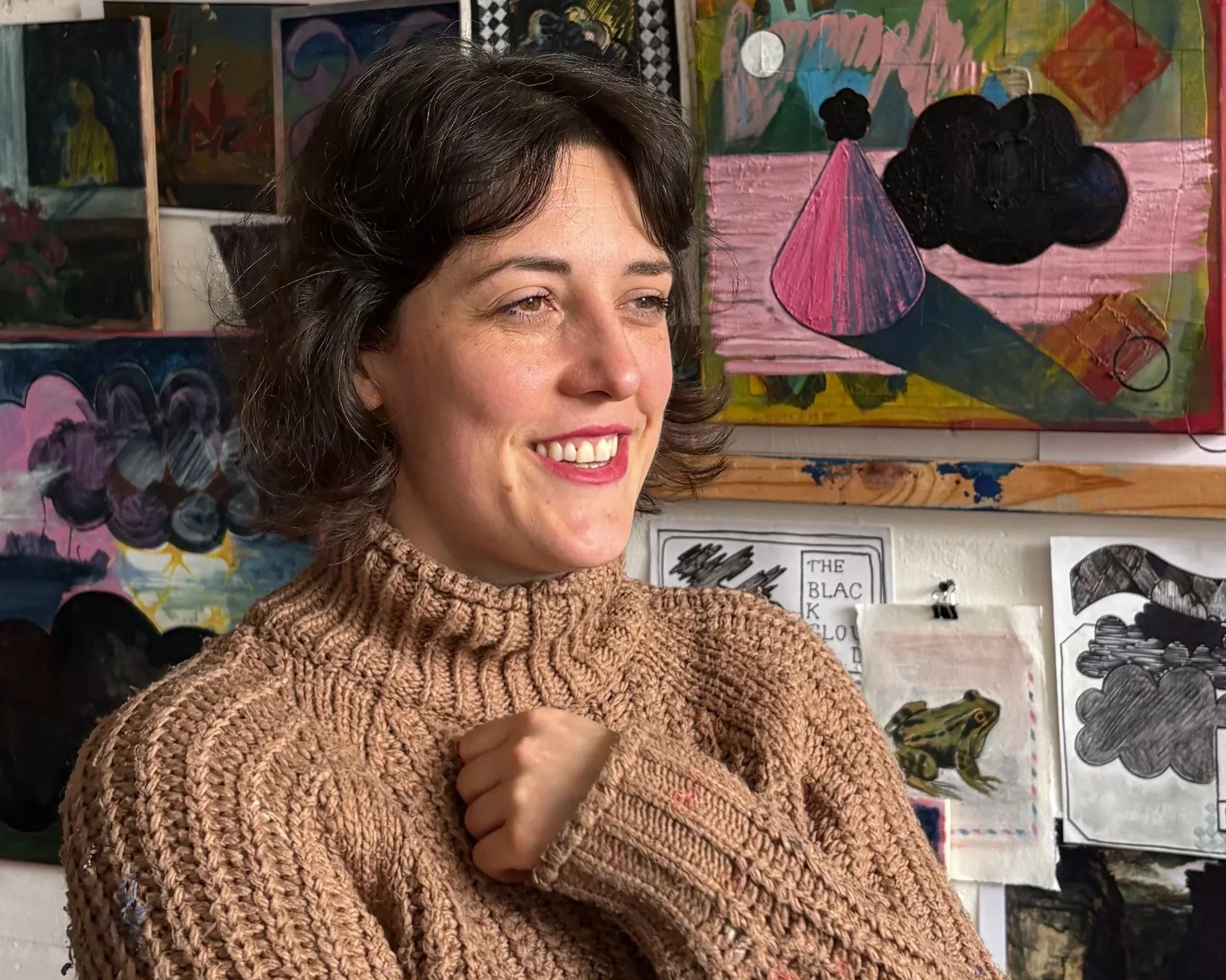
A black cloud held lightly. A very loaded title – evocative and quite suggestive in a way, from an emotional perspective. Can you talk through what that title means to you and how it relates to the work that you’re showing in the exhibition?
It comes from two things, in a way. I had this conversation with a friend of mine a while ago, and we were talking about the importance that art has in your life, and how much you pin all your hopes and wants and ambitions on it. But then, you also have to hold it lightly. It has to just be its own thing. You have to hold it in the palm of your hand and not crush it. I think that's what's so appealing about painting in itself – this line between handling something and allowing it to exist as its own entity. So, it kind of came out of that conversation – I came out with the statement, ‘Hold it lightly. It means everything’.
Then you have the black cloud element. The black clouds are an important recurring motif in the work I make. It's not in all the paintings, and it won't be in all the paintings in the show, but the black cloud was the thing that made my painting start to make sense to me. There is this psychological element to it. The way I paint the black cloud is often cartoony, or it's very simple, sort of simplified. I'm talking about these big personal ideas of mental health, or psychological ideas – but then also holding them lightly in the painting as well.
Does the purpose of the black cloud vary depending on the subject matter of the painting, or is there a throughline between what it represents in each of those paintings?
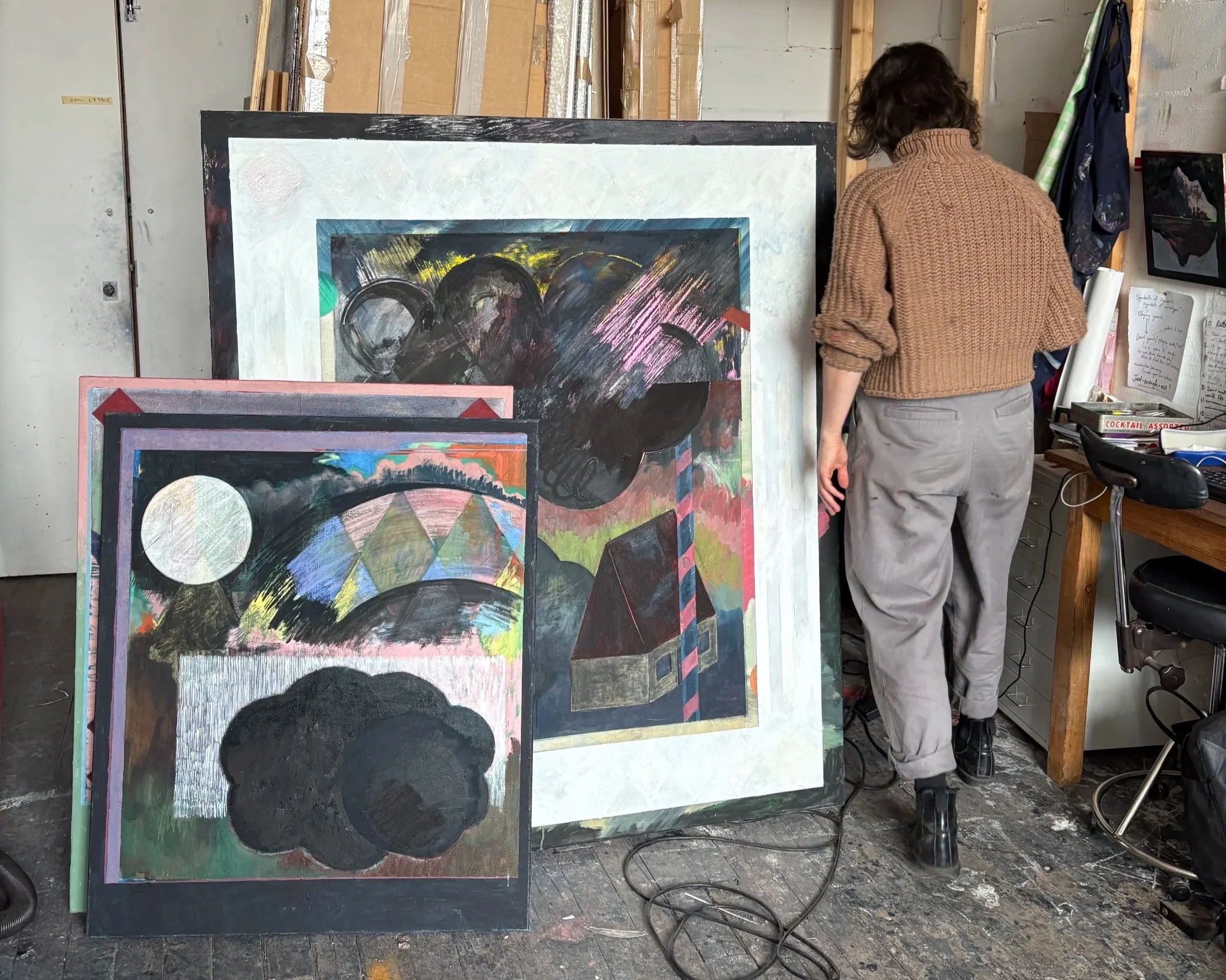
I think it really varies depending on the painting. I don't like to be too definitive in what it means. I think it has to stand alone. In some of the paintings it’s lurking in the background and becomes as much of an object as the other objects in the painting. But then, in other paintings, it becomes part of the landscape. It becomes something more abstract. The black cloud might become a black house. It can change and move. I like that. It has legs, I guess, to different feelings being expressed in different paintings.
It’s always a difficult thing, because you find these motifs in your work, and you've got to be mindful of not just leaning on them too much and being open to what the painting is and what it wants to give back to you, in a way. Sometimes I can go to the old habit of thinking I'll put in the black cloud – you have to resist that a little bit because it's too obvious. You end up having these crutches that are too easy to go to, so you have to put them back in the toy box. I often think of my work as the toy box, where I have all these different objects, toys, things, and I have to be selective about what gets to come into the painting and interact and play within that, within the field of the painting. Sometimes you have to let the black cloud play with the other toys.
You've talked about Brighton Pierrots being an influence on this exhibition, and it manages to be both incredibly evocative of a very specific coastal town aesthetic from the time, while it also retains timelessness in its depiction of the oddity of seaside towns. What's your relationship with that painting, and how has it become relevant to your Lido Stores exhibition?
My day job used to be close to Tate Britain. I used to go in on a lunch break, and I’d generally pick one or two paintings to spend a decent amount of time with. This one was always one that I would come back to. I think coming from a seaside town, the aesthetics of a place like that are something I really understand; it's like a language you speak. When I see it in a painting, it takes me back to childhood growing up in Scarborough, but it also speaks to how I see it now, as someone who's lived their whole adult life in London. I've been here for nearly 20 years, but there is still something that really draws me in about that particular feel or aesthetic. I think the peculiarity stays with you when you grow up in a place with such a specific feel; it’s funny how much of it I can see it in my paintings. I don't know if it’s as literal as colour palette, or a sort of retro-ness, or this look of faded grandeur. There's a nostalgia to those places – Scarborough definitely feels like it. We’re in the aftermath of a time when it was much more alive, and I think I’m interested in that sadness – or perhaps it’s melancholy.
That painting is really quite a strange painting. It could almost be depicting actors in costume today – Brighton seafront still looks like that. I really love the way that it's framed in such a strange way too; the way that the pole cuts the stage in half and hides one of the figures. We're almost looking at the scene from the wrong place. I also really love this dusky nighttime setting, and all the muddy, quite strange choice of colours. There are pastel colors in there, but they have quite a luminosity. Then there's all these khaki greens and dark muddy colors. It just really speaks to me.
Looking back at your Lido Open entry – how did the Open come across your radar?
It’s been on my radar for quite a long time. I remember a few years ago, when I started painting more seriously again, seeing it on Instagram and thinking it looked exciting – but I never actually entered until last year. And I think in a way, I knew that my work wasn't ready for it. I wasn’t really making small works before 2025, which is what I needed to enter.
I really love the painting I entered. It's a strange painting that was a little bit of a departure from what I thought I made. There were a few things happening under the surface. I didn't really know where it was going – there were some shapes and abstract bits that emerged when I was working on it. And then I'd been doing all these black paintings, or black cloud paintings, where black was such an important part of what I was thinking about. And the challenge to myself was, OK, well, what if you make a white painting – which is why it's literally called White Painting – and flip from what I would normally be painting. It landed naturally on the surface with the little house, and the shape of the black cloud is in there. It comes off as perhaps trees in the distance, more of a feature of the landscape. I thought, OK, I’m just going to leave that. And it sat on the shelf for a long time; I was really unsure about it, because it felt so different. I love it now. I think it really helped to open up my practice.
It’s funny, because you have these rules that you set for yourself as an artist – I do this, I don't do that. And that painting was me supposing to myself, what if you do the thing you don't do and allow yourself to open up to other ideas and challenge the ideas of why you say, I don't do that.
Does it take you out of a kind of comfort zone to do that?
I don't do it that often, to be honest. Maybe I should do it again. I think it's a good way of loosening up a little bit and challenging the ideas of what you think you are. It’s how I broke out of quite a difficult period of artist’s block – make a list of all the things you think your painting is, make a list of opposing ideas and then make a painting with the opposing ideas. And the things that stick are the things that are obviously important to you for some reason, so allow them to stay.
And what was your experience like on the night of the Open?
Oh, so fun. I came over to Margate and met up with a friend of mine. I really didn't think I was going to win. We swam in the sea that afternoon – so nice, so lovely in September, amazing. We ate some chips, then came up to the hill to the show, and I was completely bedraggled and unprepared to win. Just before you announced the winner, I turned to one of my friends and said, ‘Oh, I hope someone we know wins’. I was just so excited – have Sophie and Kristen pick my work is just such a brilliant seal of approval. And it came at a really important point in my art making – it really felt like confirmation that I should keep going after a tricky time. I’d just finished studying with Turps art school and, you know, it's always difficult when you stop being part of an institution like that and having to go it alone. And it felt really great to have this feeling of affirmation to keep going.
What was your experience like with Turps?
I did the Correspondence Course for one year, and then the Offsite Programme in London for two years, and they completely changed my life. Before that, all through my twenties and most of my thirties, I'd drifted about a lot- the wilderness years definitely happened. I tried lots of different jobs, I made art, I stopped making art, I came back to it, I stopped again. When I started to be serious about painting again I joined the Correspondence Course. The main thing that Turps opened up to me was a community of artists who feel the same way. It was revelatory to meet all these people and instantly have this bond- people who understand why making art is so important. You get to skip the explanation, you just go straight to talking about the work and being a nerd. The Offsite Course was more rigorous, but having group mentoring and tutorials in person helped me learn how to talk about my work and take it seriously. I owe Turps a lot.
You touch on that idea of the wilderness years, and then Turps being a big part of taking painting more seriously. What was the inspiration, the driving factor, to do that — to think, okay, I'm going to do this course now? Because it's a commitment, right? It's not something you do lightly.
Do you know what it was? I got to my mid-thirties, and a lot of people around me started having babies, and I realised I really didn't want to do that. It's a really difficult time when it feels like your paths are diverging from a lot of the people that you really care about. I realised that I had to have something that would be just as important and worthwhile as having a baby. What I love about painting is that it's something I'm never going to retire from. This is going to sustain me for the whole of my life. It's always going to be there for me. It's something that I have to nurture, much like having a child, and it has given me something to be serious about, something that really matters to me. It's something that I have to fight for as well. There are so many things in life that are going to pull you away from it, but if I approach it with that level of seriousness, and I remind myself of why I'm doing it, it really makes it a lot easier to fight for.
I think it's a fairly universal thing, isn't it? You meet so many artists you meet who are just battling those pulls all the time. It never stops. How did you sustain your art practice before Turps — you mentioned working different jobs — up to this point?
Well, that's the truth of it- things take priority. And the change was the decision that this is going to take priority now.
Routine is what keeps it rolling along — just being completely devoted to it. It's hard, I work a full-time job and I get up really early; I get to the studio just after 7am, and then I do a few hours' work, before having to log on to do my office job. You really have to weigh up what's most important, and that can sometimes be quite a battle, when you just want to have leisure and fun but you have to go to bed quite early. You're working six days a week. But I don't know — I wouldn't be without it. It gives me so much purpose. And I love the routine. I love getting up early, and getting to the studio. [I’m in the studio] every day during the week, and then Saturday I allow myself a slightly slower start. I mean, the ideal would be about five hours a day painting. I don't manage that midweek — it's more like three. But then Sunday has to be the day of rest.
How rigid are you in your process? Do you have a set way that you go about creating when you land in the studio quite early in the morning?
It depends on which point the work's at. At the minute, we're dealing with a lot of nearly finished works, so it's quite a different game now — it's a bit more like pottering around. But normally, the routine would be: I get in, I put Radio Four on, I get a big pot of coffee going, and I just crack on. Some artists need to circle for a while; I just kind of go. I think part of the appeal of the early-morning start is that my brain hasn't got full of noise yet, so I can come in with a fairly clear head and just start making and doing. I think the answer is in the making and the doing. Sometimes I'll mess things up, and that's fine, but the cogs will start turning because I'm in it. I will probably go between paintings — I've got lots on the go at the same time. Or there might be one particular painting that I'm really into, that's really working, that I want to stick with. The process requires waiting between layers to dry quite a lot, so you need to have a few paintings on the go. You can't just stick with one for weeks on end. And then drawing is probably where I can loosen up a bit, if I need some ideas, or if I feel like I'm killing the painting. I have a hang-up that I'm here to do a job- I'm here to work, and I feel like I need to be working, and that means literally painting — I’m not the best at sitting and stopping and thinking about things, also because my time's so precious. It's something I'd like to get better at, to be honest, but I do think the answer is in the doing.
When you're working on, say, a new painting, do you work very quickly in your actual making? Or is actually putting the paint down a slower process?
It really varies. There are two types of painting that happen. There are the paintings that are a little bit more thought out, so then the process is about building up layers and getting everything to sit right, getting the atmosphere and the colours and the textures correct, and that can be quite a slow process. Then sometimes the paintings are more about allowing there to be freedom within the work — laying something down, waiting for a bit, going in on it again, and it sort of reveals itself a bit more. Those are the slightly more abstracted paintings that I do. I think it's good having the two processes alongside each other. If I just did the paintings that were more like still life — that are quite thought-through, more a case of putting in the time to work at it — if I just did that, I would get completely bored. I need the ones that allow for a bit of randomness or chaos to happen. A bit of uncertainty is good for me sometimes.
To what extent are you planning the paintings in drawings, or on a smaller scale? What's your process there for working up to a composition?
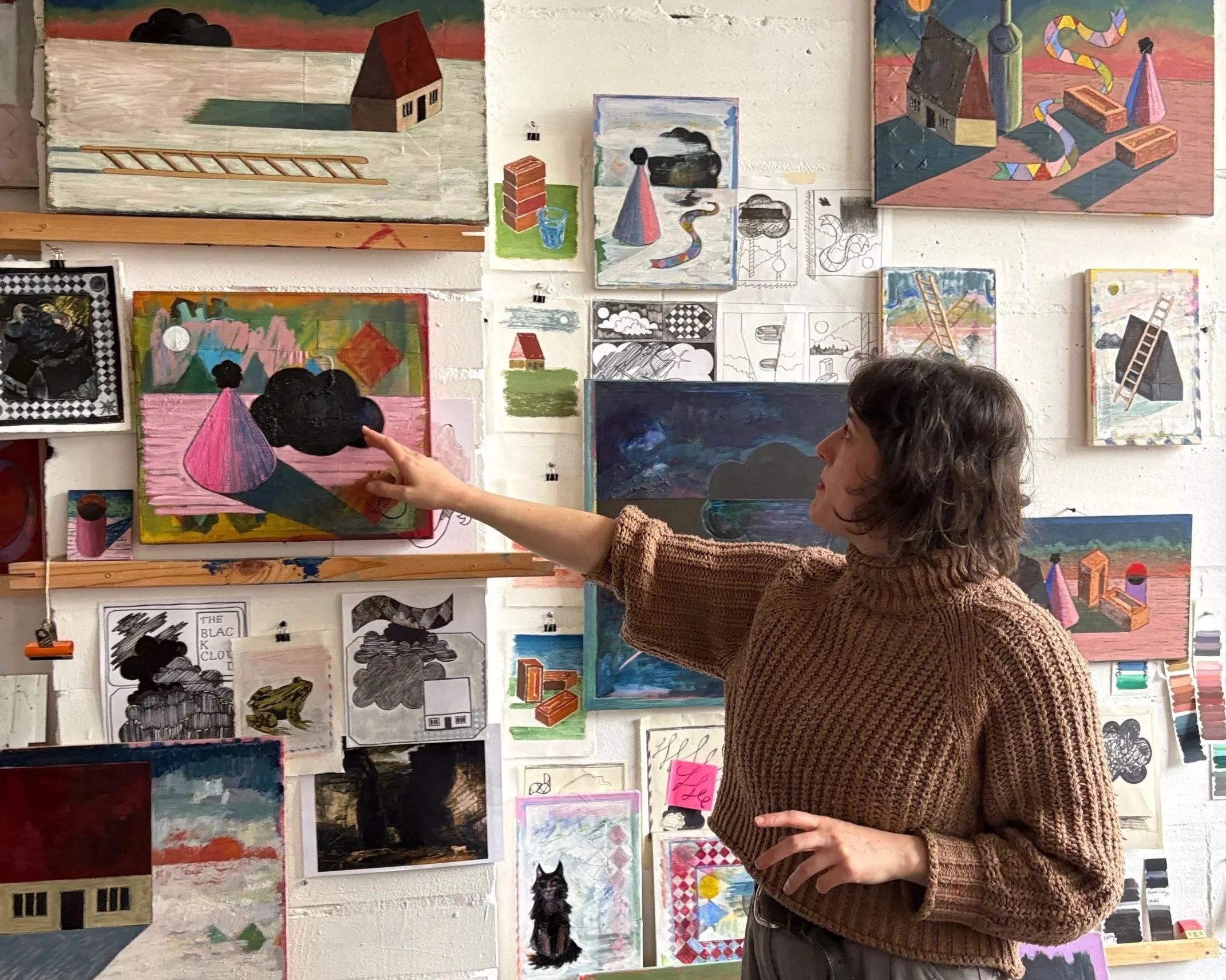
Yeah, I do draw to help me figure out where I'm going, and they vary too. So sometimes it's something more abstract that feels like problem-solving — like, how can these shapes interact with each other? Sometimes I'll be making a painting, and then I need to go back to drawing to help figure out the mechanics of it, or where it might go. Sometimes it's more like a plan. And then some are more a case of laying down the objects and seeing how they interact with each other, and I'll do different versions of it to get things in the right place. I think these are quite interesting, because sometimes I will be drawing out objects, and I think of a new object to bring in, and so I need to learn how it plays along with the other objects. But then sometimes I'll lay things down and I'll feel it in my chest, like, oh, that feels like something, the way that those are sitting together. There is definitely an instinctive element in what I'm doing. It has to feel true in some way, if that makes any sense.
Yes, it does. What's the inspiration behind the compositions – I'm not talking necessarily from an artistic perspective, in terms of other artists' influences, but for you as an individual with a need to express something, what are you aiming to express within your work?
Well, a lot of the objects in my work come from dreams that I've had, or are in my life, and I think painting is a way of making sense of those things. Maybe it speaks to a subconscious level, where I get to explore the relationships between things and objects in the work that I might not have really considered in my life. It works on quite an abstract level, but it is me making sense of things. I never draw people, and I think it's not that the objects represent people, but I have a lot of emotional attachments to the objects. It is very much about relationships, the work, and how these objects, shapes and colours relate to each other and build a relationship — or don't build a relationship, perhaps. It comes from quite a deep, core place.
The style you’re working in at the moment — with the objects, and imbuing them with their own sort of personality, in a way — is that something that you've typically been doing since early on in your art career?
It was pretty recent, really. I did my BA at Goldsmiths nearly twenty years ago now, and having had that background of art making, it was very much — it was the noughties — it was very much 'not painting'. And very much 'we don't care about you; don't make it about you, make it about something bigger; think about the world.' I think there's a lot of good that I've taken from that, but it created this very difficult hang-up that has taken me a long time to get over, where I took that and turned it into 'never put yourself in the work.' So for a long, long time I was making work, but it just wasn't working. I was making quite abstract paintings — shapes and geometric forms and stuff — very painfully, and I knew it wasn't good. I found it so difficult because I didn't know how to get out of that. And then I started to allow myself to be in the work, and that's when it started getting good, and it feels much more authentic because of it. I don't think I have to tell you my life story, or my deepest, darkest secrets, or my traumas — but I have to allow for myself to be in it, because otherwise, what's the point? I can only make what I can make, and I have to be OK with that. It was when I started looking inwards a bit more that it got interesting.
I saw the Mike Kelley show at the Tate — when I was really questioning what it is that makes my work mine. His work is nothing like mine, but it really reminded me of why I love art so much. His work is very conceptual, and there are a lot of ideas in there, but it's still personal. He's still in the work. And that came at the right time, I thought, oh yeah, I can do that. I can put myself in the painting. I know I keep talking about it being true, but it does come from a real place now, and I think that's why the work is much better than it used to be.
Is that a motivator for you to paint? I feel like everyone, particularly with the world being as it is, needs a way of decompressing and processing. Does that filter through as a motivator into your work — to be painting, and to be painting prolifically?
I think possibly, yes. I think the motor that keeps me going is that the painting is a puzzle. I want to solve the puzzle even though I don't even know what the puzzle is. But there is an unanswered question that I feel the painting might answer for me. And painting does reveal things to me about myself — not to make it completely self-reflective and self-indulgent, but it gives me the ability to tune into myself, and then turning it into something that exists in the world that hopefully other people can tune into too. So, it is a way of connecting to myself, but also connecting to others whilst I do that. Which is partly thanks to Turps as well — just understanding you can do that. You don't have to be a closed book, people respond to that; it gives something to other people.
How important was Turps in that realisation?
At Turps you don't have to explain why you're painting; you can quite quickly get to somewhere a bit deeper. Meeting people at all different points in their lives at Turps, and we're all sort of trying to do this thing where we communicate something to each other. Sometimes I think of it as: we're all at a sort of language school, and we're all trying to learn this new language together. You don't even know what the language is, but you're trying to learn it. I often think that's what painting is, in a way. You write a letter in a language you can't read, and you send it off into the world, and you hope that someone writes back to you. There's a painting of my cat that I painted, and it's got the air-mail markings along the side of the painting. My cat had to have an eye removed last year, and it was this horrible, horrible thing, where with a pet, when they're sick, you can't explain to them what's happening to them. That painting was me trying to write a letter to my cat and also to connect to the frustration of not being able to communicate what I wanted to.
Was painting always going to be your way? Or did you explore other mediums when you were younger, or along the way?
I think painting was always the thing, really. I did try other things — I did a bit of performance art. There's definitely a thwarted thespian inside me. I did a lot of photography and light installation at Goldsmiths. It's funny, because I look back on these things and I think, that was a bit random. But then when I actually drill into what it was, I can really see the themes were already there in some of the work, I just didn't know how to grasp them properly. It's taken some time for me to feel confident enough to grasp them, and to be able to show them. I mean, painting is just so personal. You're such a romantic figure, as a painter — 'here's this thing that I made, please look at it, but hold it carefully.' It's sort of ridiculous and silly, it's like wearing your heart on your sleeve. It takes a lot of courage to do that, and it takes a lot of courage to really put yourself in the work. I think that's why I was avoiding doing that as well, because I was scared of revealing too much about myself, or anything at all. And I feel much less scared of that now.
Was there an initial reticence about showing the work that was more personal?
Do you know what? No! Because when it started getting more personal, I actually felt more able to defend it, as it felt more like my own thing. And it's funny, it's a tentative thing, showing your work. I was terrified of it for quite a long time. But you get to a point where you realise: if I'm a tree falling in the forest and there's no one there to hear it, do I make a sound? You know — am I making this work? I need it to exist outside of me. There's such an inherent difficulty in that. You have to make the work that you want to make, that feels right, and in an ideal world that would be enough. But it isn't, because you do need to have people see it. And I always feel a bit uncomfortable about what it is that I'm wanting someone to see.
I suppose you're not telling people how it should make them feel, or how you feel, or what it's about explicitly. It's that thing you were saying about not revealing too much. That's something that — I'm not going to say it's unique to painting — but it's certainly something that painting allows you to do in quite an adaptive way, I think. Apologies, that’s not a question.
No, I like that. I agree. I like the work to stand on its own, to be its own — to use the metaphor from earlier, its own child, its own being that exists in the world. It comes from me, but it exists outside of me, and that's all right. I like it when it surprises me back. And I like it when someone says, oh, I see this thing in it, and I hadn't seen it at all, and then it's right there. Sometimes it's something so obvious and you've not even seen it, and it just takes someone else to point it out to you. I like that, I'm happy for that to happen. I'm not the god of the painting; the painting is its own thing.
What's the best advice you've been given as an artist, by another artist?
Two things come to mind. I was talking about this the other day: Marcus Harvey's advice of 'ambiguity, not vagueness.' So, there can be room for mystery, but if you're just dancing around something and not being specific, that's not the same thing.
The other one — I can't remember who said it — is to 'do the thing.' Don't be scared of the cliché; just do the thing, the thing that you feel scared of doing. Go to it. If you're going to bother, bother — do it. Something that's obvious to you isn't actually obvious to other people. Don't be scared of the cliché.
Just to finish, I thought we could do a quick-fire ten questions — not related, well, largely not related, to art. Just ‘Get to know Laura L Bell’. OK?
Yeah, fun wrap-up. Like it.
OK: Best exhibition you saw within the last year.
Oh God, I'm going to go Andrew Cranston, on right now. I love it.
Best way to relax.
I'm terrible at relaxing. God…
You can say 'not applicable.'
It might be not applicable. I've recently got into reading quite a lot, and that has actually really helped me learn to relax.
Favourite TV show?
I actually don't really like telly that much. But favourite current TV show… Hacks.
Very good. Best film you saw recently?
The Worst Person in the World. The Joachim Trier Oslo trilogy is all brilliant but this one I love the most and rewatched recently. I love that film.
Favourite holiday destination?
Oh gosh, I definitely don't get away as much as I would like to. It's a toss-up between — I went to Japan many, many, many years ago, and loved it — or Paris. I lived there for a little bit. Yeah, Paris or Japan.
I feel like I know the answer to this — cats or dogs?
Oh, cats. Yeah — sorry, dogs.
City break or beach holiday?
Oh man, that's difficult, you know? Because, ideally, it'd be a city by the sea.
Most-played song?
Ah, this is harder — I mean, music's just so important to me. I listen to music and the radio constantly. I think the most listened-to song last year — and I think it's been the most listened-to song for like three years in a row — is by Black Country, New Road. It's called 'Track X'. That's from their first album. Their most recent album, which I've also listened to to death, is quite different. I love them so much.
Fried breakfast or continental?
I would like a sort of — I want, like, poached eggs. In a dream world, I'd have egg every day for breakfast.
Oh, I'm the same. I just can't poach eggs. I just — yeah, I try, and my God, there are some horror shows.
Yeah, sometimes it doesn't go to plan! You need really fresh eggs, and you need quite a lot of vinegar in the water. The other trick to a good egg — so, I was a chef for a while — depending on the age of the chicken, I think it affects the egg. So, some eggs are really pointy; you don't want that for a poacher, you want one that's quite round.
I mean, that is a tip I could not have predicted would come out of our conversation. Thank you.
Just hours of poaching eggs — it's things I've learned.
Love it. And this is the final one of the ten — favourite comfort meal.
That is so difficult. Probably beans on toast.With an egg.
Arguably can't be beaten — fabulous little snack.
God, I eat so much bread. It's unholy how much bread I eat. Ridiculous.Honestly, I started making my own bread recently. I don't know if that's a good thing or a bad thing — like, I make a whole loaf of bread, I eat it, but it's made by me!