Sheila Rennick
Disco Disorder – great title. Where does it come from?
There were a few inspirations, really. My practice is disordered, especially at the moment, as I have a lot of paintings on the go at the same time, particularly making smaller works for Margate – it’s a bit of a frenzy, and I’ll get them more ordered once I come back to work on them. I thought about listening to music, because I’m always listening to music in the studio or when I’m walking through London – that can be a real influence on how you’re processing things day-to-day, and how you feel once you’re in the studio. It’s a bit of a random one, but I was also thinking about disc disorders – back pain – as all of us siblings have had back problems of some sort. Away from anything influential, I wanted to come up with a name that people would remember, that is a bit different from the usual more flowery titles. That’s a bit long-winded, but you can take from that what you want!
Turning to Disco Disorder, what’s your impression of the Margate arts scene?
Well, it’s happening in Margate, this whole cultural thing, isn’t it. It’s amazing to see the change from when it was an empty seaside town only a few years ago. There are some great galleries, and some serious players there with Tracey Emin and Carl Freedman that have brought a lot of great talent to Margate. It’s still quite an affordable place to live outside London – that’s one of the upshots of Covid, I think, it people being able to move out of the city, and that’s appealing to artists.
Have you drawn inspiration from Margate and – not to put too fine a point on its rough edges – the theme of the dilapidated seaside town?
For sure; not necessarily Margate specifically, but the familiarity of the small town. There’s one painting in the exhibition, Small Town Glory, which is of the town square in Tuam, where I grew up. I had a memory of a couple rolling around drunk. It evokes those memories of small-town desolation, people being very intimate in public and there’s often drink or drugs involved. It can sometimes look a bit sad. People can get trapped in those places.
Margate’s an interesting town – you’ve got gentrification in one part of town and an eighth of a mile up the road is abject poverty.
It’s weird, isn’t it. When I’ve visited Margate, I’ve seen some quite sad characters about. Last time I was here, I bumped into a guy with a face covered in tattoos. I could have the same interaction in Lewisham, and it’d feel more like someone’s choosing to live that way, whereas in Margate, it feels more like he’s stuck in that way of life. I’d feel sadder for that person in Margate. I can’t quite work it out.
It feels like the exhibition is offering a macro look at certain parts of the socio-political spectrum, which, as you’ve alluded to, is very relevant to Margate. What was the genesis of that as an area of interest in your practice, and how has that evolved over the years?
As an artist, I think the social aspect of life is something I’ve always engaged with. Growing up in Tuam, a small town in Ireland where my parents ran two businesses, it was always very people-centric, and you came across a lot of very diverse people who all had their own stories. I’ve been out a lot – spent a lot of time in pubs both here and in Ireland – and I’ve worked so many different jobs, so there’s a lot of characters to draw on. I’m interested in people and life and what’s going on around me socially, and I’m always engaged with the news and social media – perhaps to a fault. My work is about the immediate and what makes people tick – what I find interesting and funny.
I guess it’s evolved in the sense that I’m older now and I have more of an understanding in life. I can pinpoint things that I want to say a bit better – maybe the painting and the storytelling is getting more mature and less frenzied than when I was younger and using it as a tool to try to work things out. It’s less about discovering what I felt about something and more about knowing how it makes me feel and working that into the painting.
It’s a sharp change, in so many ways, to go from living in a small Irish town to London. Has there been a conscious change in the social commentary element of the work after moving to urban London?
There has, but you always take the humour with you. In Ireland, it’s all a bit humorous. In a small town, you’re got your characters and your weirdos. Tuam was kind of cozy; the people who were very individual, very different, were embraced. Certainly, anyone who was suffering a mental illness was kind of sheltered. It’s part of the landscape in London, on a different scale. Sometimes in London, those characters don’t always seem as tragic. I don’t know why that is. How has the work evolved? I’ve never really thought about that before. I think you need to make work as you find yourself – it’s always evolving and changing as you’re working in different places and you’re growing and maturing. Those life changes are probably the greatest influence, as your own worries and interests and the demands on you take on different forms.
Your work is driven by storytelling – narratives and parables. When you start a new painting, are you designing the structure of that on a particular drawing from literature or the real world, or is it an organic process you’re eking out as you’re putting paint down?
It’s funny you ask that, as I actually looked at my old sketchbook from college recently. I used to make comic strips, and there was much writing in my work. I used to write loads of poems, and often words or phrases worked their way into the paintings. It became a problem and they used to tell me during my masters, Sheila, if you’re going to paint, you can’t just keep writing in everything – you’re going to need to say what you need to say with the image. So, that’s what I try to do when I get an idea – to find the best way to present it through imagery. I’ll try to create a scene with it, which might start off with a photo I’ve taken and then I’ll source more images, either online or from my imagination, and start working up a collage. More images may emerge as I work on that collage and then as I start painting, so it isn’t rigid. That’s where the surreal element might come in – popping in something a bit weird. So, they are planned, but not strictly. And I’m definitely not throwing words into my paintings anymore!
I think because of my life with two kids, you’re living under restrictions. You might have something in your head for a while, and you’ll have lots of time to think about it, then it’ll take longer to actually plan it before I finally get a chance to go into the studio and work on the painting. That’s made it less immediate in the way I process things and the way the works develop.
Have your paintings changed as a result of that?
I was an Office Manager before I had kids, full-time, and I shoehorned painting in during the evenings and on a Saturday. I’m lucky now if life allows me to get to the studio three days a week, and they’re not full days. I have more allocated time now than I did before, really, which has helped to get the work a bit more organised. I can be with the work a bit more now – doing it after a full day of working, you really are shoehorning it in when you’re tired and without the time to just sit with it, whereas now I have set aside that time to just go and paint so mentally, I guess I’m working towards those days. There’s more energy for it.
It’s an interesting recalibration. Do you find that the physical 40-minute distance between your home and your studio in Kingston helps you get into that headspace?
I think, before kids, I could have very happily had a studio at home with my husband. I can’t do one now, because I need to get away from the domesticity. It’s too much. The kids are trying to bang down the door and eat oil paints and all that madness! My husband works from home too and has a workshop at the end of the garden, and he’s hiding in there of an evening working away. That’s how he gets away. I need to get away too – I’d go crazy otherwise.
The amount of time you have to paint is necessarily compartmentalised. How do you reconcile with that – is there a frustration around the limitations and has it approach how you’re approached your career aspirations?
As an artist, I’ve always been frustrated because I’ve always had to work jobs to support my practice and felt like art has been something I’ve needed to fund. I’ve wanted it to be the main thing I do, but that’s not realistic. So, I’ve become used to being frustrated working a job, and being a mother, parenting and time being snatched away isn’t necessarily new. I make peace with it – that you’ve only a certain amount of time for it and you need to be fluid with it. You can always consider an idea or have a sketchbook with you that you’ll later pick up on in the studio.
When you’re in the studio, are you working in silence or do you paint to music?
I think noise gives you a bit of a vacuum and takes you out of yourself a bit – it could be an audio book, an interview you’re listening to, or music. I think I just need something else to serve as a distraction.
What’re you listening to?
Oh, God, what have I been listening to! I’ve been listening to bands like Getdown Services, Cooper T and older British post punk bands like Delta 5, Irish music like Fontains DC and Roisin Murphy, pop songs, soundtracks... Whatever pops up, really. I was listening to the Nil by Mouth soundtrack lately, some Lily Allen and a bit of Dolores Keane – some very diverse options there!
With the painting itself, on the surface of it, there’s a bit of chaos and a complexity to it. They’re vibrant and busy scenes that you’re depicting. Is that a reflection of your processing of these stories and events that you’re reading about and witnessing that are filtering into the work?
For sure. I think there’s a real urgency when I’ve thought about something and figured it out – or I’m trying to work out how it makes me feel – to just get it on the canvas. A physical urgency to get paint down. I think it is part of the process. The composition might be off, it might not work at first, and that’s then something I need to figure out as well.
Do you work quickly on multiple paintings at once?
I’d say I’m normally working on three or four paintings at once, because I get kind of bored of the idea once it’s ‘out’ and painted, and there’s a pull to move onto something else, but you then have to return to it to make it a good painting. Some of them I leave for six months or so; I then need to get into the idea again, into that headspace, convince myself I’ve not finished processing it, and go back to work on it.
Where do you find the motivation to revisit those older paintings once your mind has moved ahead?
I think you should just say to yourself, is it worth saving? Is it actually going to come out well? If it’s a yes, you need to go back and finish it and the belief that it’s worth saving is the motivation. Sometimes I catch myself looking at the older ones in my studio and I think, oh, God, I really need to go back and finish these – or not. Be ruthless!
You work has a social commentary going on beneath the surface. The scenes they depict can be controversial or challenging, but it never feels like it punches down. It’s an observation with pathos and compassion and a bit of sentimentality.
There’s normally an emotion behind it – I’m never looking to belittle someone or a group of people. It’s often related to a particular concern. It comes from a good place; I’m not interested in criticising. Some of them are emotionally charged – it’s a physical response to something that’s worried me or that I’ve been thinking about.
Do you find there’s a catharsis for you in painting those scenes, particularly where they’re riffing on particular issues or stories that resonated?
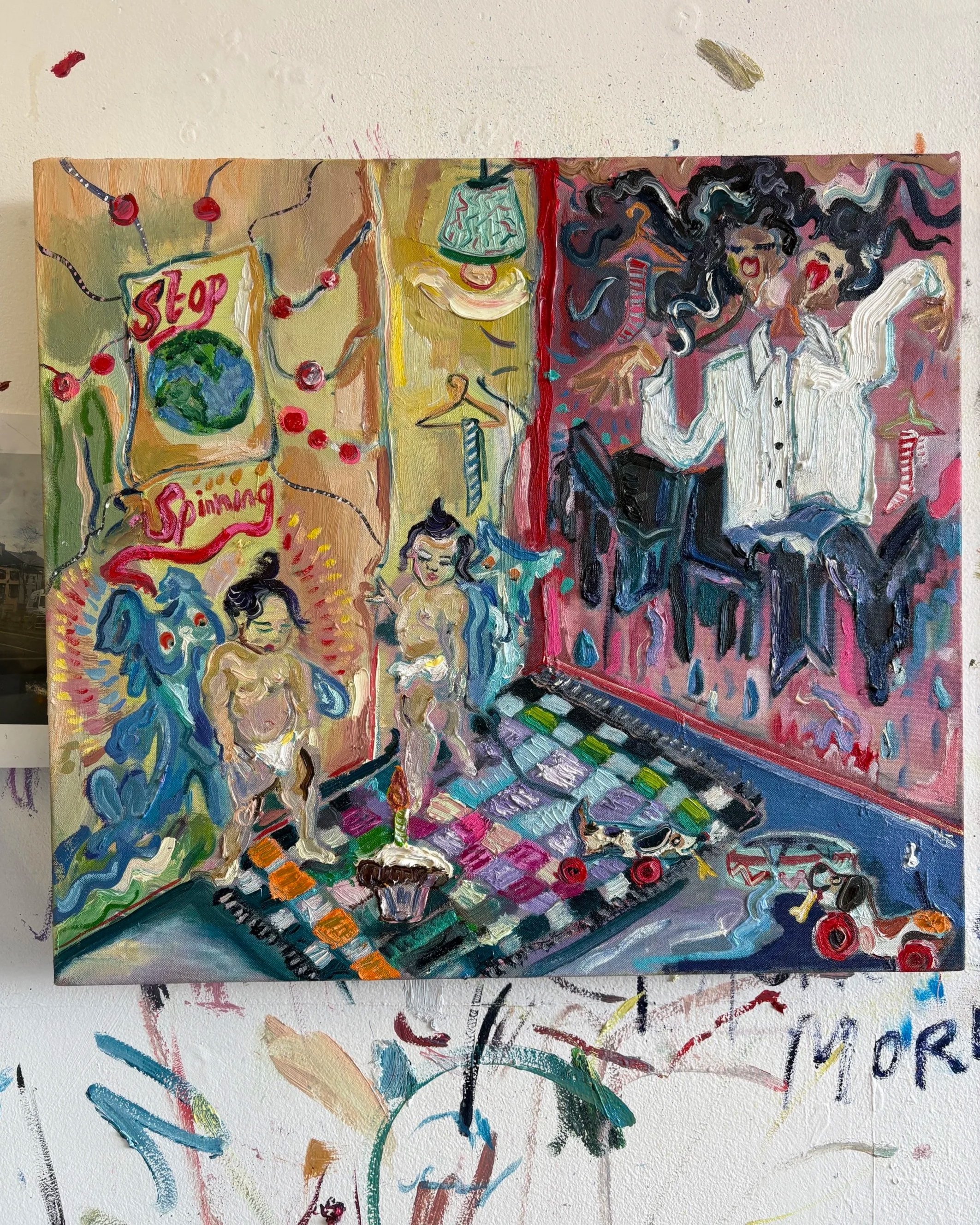
Oh, for sure. Take Domestic Disturbances, for example. That was autobiographical, because that was the first painting I did when we moved into our new house as a family. I was quite upset at the time, and I wanted to paint what I was feeling about the disruption of home life. It’s definitely all cathartic. I’m trying to put my feeling on things and my emotions about things into the painting – I’m not trying to change anything, I’m just trying to release something that people can connect with and relate to, and to turn that into a bit of a release.
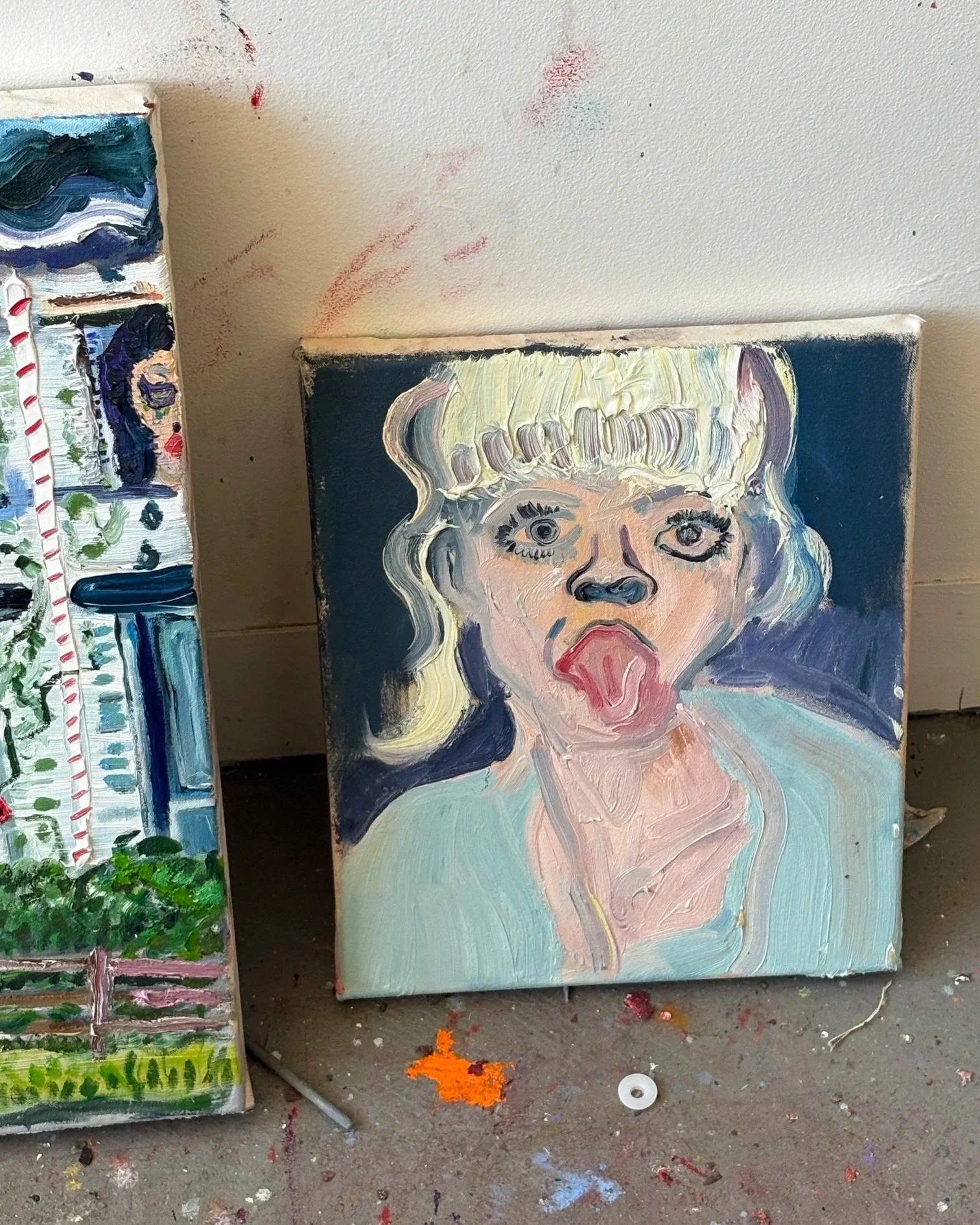
Your work is often thought provoking. Would you say there are warnings in some of the sharper paintings that riff on social difficulties? You also mentioned the autobiographical element – is that something that plays through a lot of your work?
Maybe the warning is to be more self-aware and not to bumble along – if it provokes people to be aware of the issues I paint, then grand. These characters and these issues are all around us, but we’re so absorbed by our own drama that it’s easy to just turn away. Perhaps it’s confronting things that can be difficult to look at head-on.
Dutifully Distracted is of me minding my daughter, feeling frustrated. Price Match as well – shopping in a supermarket with my daughter and she’s smashing eggs and just being a bit of a nightmare. The frustrations of motherhood, coupled with worries about the cost of living. That stuff doesn’t go away when you’re trying to keep a family going!
Some of those that aren’t autobiographical feature characters who almost feel lived in. There’s a realness and rawness to them. Do you formulate the characters within the narrative you’re painting – are they based on real people or amalgamations of people?
It’s a bit of both. There’ll be a lot based on photos I’ve taken or found. Then there are common motifs – like the sex dolls that just seemed to pop up in paintings over the years. So, characters might be taken from photographs and I’ll mix-match then with a surreal motif that I’ve used, and other fictional characters.
Is there an unconsciousness in some of those motifs reappearing, or are they consciously worked into paintings?
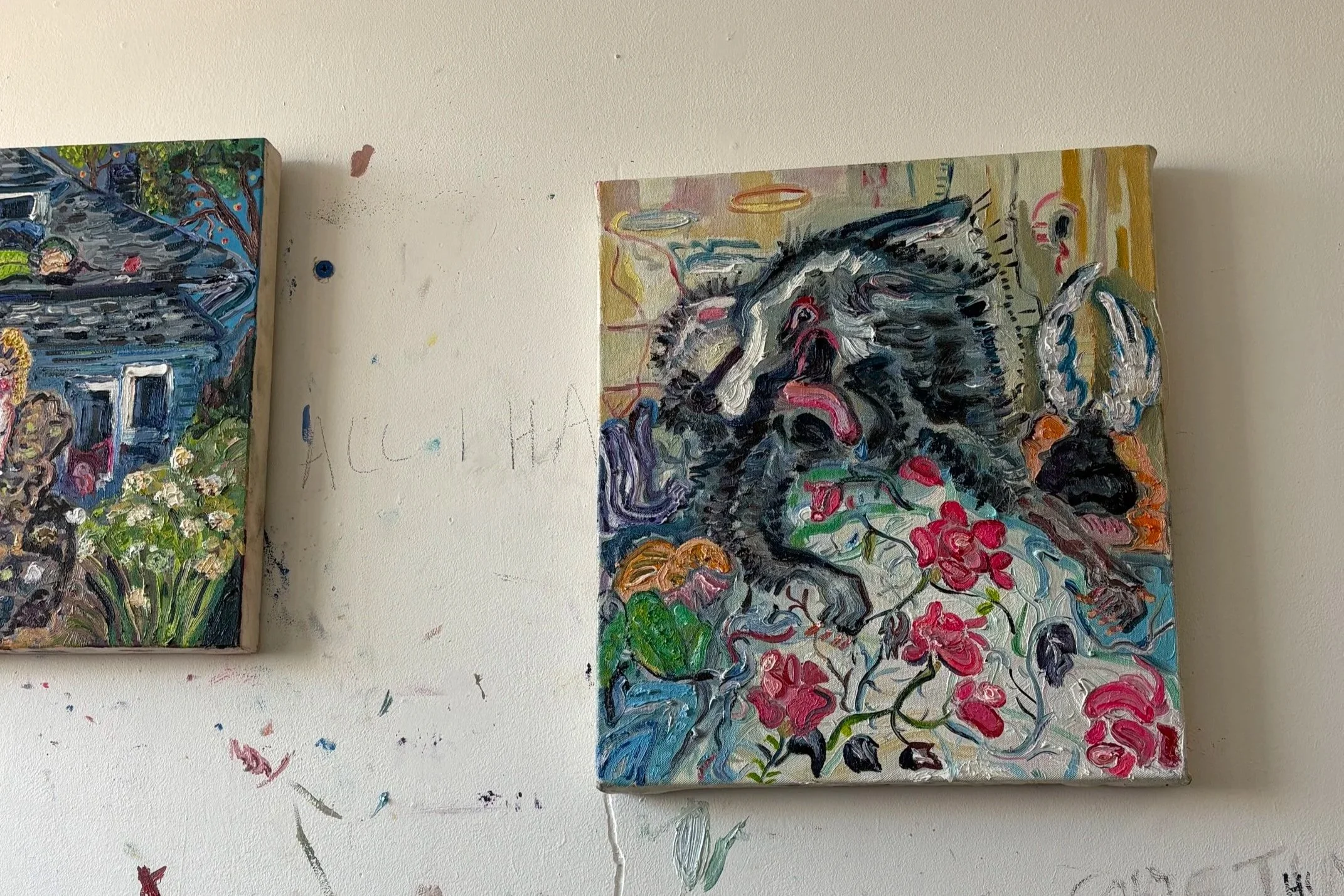
The sex doll is a common one – she symbolises some kind of tension. I often use different floral patterns and designs, which just organically appear if they fit and it makes sense, and they symbolise emotions, but I don’t think it’s an absent-minded thing.
I love the application of paint in your work as well, and the use of colour. I wondered how your relationship with the medium has evolved over the years?
It’s funny, isn’t it, because how much of it is your heavy-handed way to slap on loads of paint? I’m not a neat, slow kind of worker who layers – that’s my worst nightmare. It’s probably a reflection of my personality. It’s interesting looking at my old sketchbook. I worked in black and white with red, and I struggled with oil paints because they’re not as immediate as acrylics and inks. It wasn’t until my Masters that I started using oil paints properly and it’s only in recent years that I’ve started learning about the different types of colour I can use and investing in good quality paints. The Salted show [at The Lido Stores] was a good exercise for that. I was using less paint, buying more expensive pigment – you can’t get away with poor quality paint on a smaller surface – and knew the paintings had to be good at that scale in terms of the vibrancy of the colour.
How does your mindset change working at smaller scale?
They’re more like little stories that you engage with in a different way. They’re almost like little cakes that I’m working on. There are smaller adjustments as I work on them and it’s a physically different way of connecting with them. It’s more intimate.
Do you enjoy the freedom in the gesture of a big piece?
Definitely, yeah. You’re using your whole body, and you’re physically engrossed in it. Perhaps there’s more intensity because of that. They might be less thought-out, more immediate.
When you’re being driven by a particular idea, and I’m thinking about the cathartic element, is that better suited to working big and losing yourself in a larger canvas?
It can do – I’m contradicting myself here, but the very large painting I had in the John Moores last year called Girls Gals was made very quickly. I remember being excited making it. I’d done so many drawings that I knew what I was making and I knew it had to be big, so the actual painting was very quick for a work of that size. In a way, it doesn’t matter, because big or small, if the picture doesn’t work, the picture doesn’t work. I think with a big piece, I know I really need to know what I want to say and what I want the composition to look like. It’s more of a journey with a big piece, whereas with a smaller piece, you can just start again and take it in a totally different direction.
You’ve touched on your art studies and the work you’ve done to support your practice. What would you cite as the key turning points in your practice?
The year after I left my studies in Dublin, I was awarded a CAP Foundation Award and then moved to London when I was 22 to do my Masters at Byam Shaw School of Art. Then I went back to Ireland, and friends were opening galleries and there was a great feeling in the Dublin scene, and people were really good in helping me get my work seen. All of those were turning points, really, that moved my practice forward – learning, experience and opportunities which subsequently led to me showing with Kevin Kavanagh Gallery in Dublin.
What really helped me, though, was getting a really cheap house in Dulwich, which saved me in London. I moved into that when I was about 30 and had the downstairs front room as a studio. The landlady only charged me £700 a month all in. That was a really, really lucky thing for someone struggling to make it work in London, but it meant I had the freedom to paint at home, without the need for an expensive studio, which also meant I could paint immediately after getting home from work. It removed that financial pressure and the fear of making ends meet, you know? Later on, I did the Turps Offsite course, which was good to get me back into thinking about painting again [after having my first child]. You know what, though? Whatever happens to you, if you want to paint, you just need to do it, and it can be painful, and you can be skint, but you find a way to make it work.